AI Overview
If you’ve noticed that your home has a sagging ceiling, the first question to answer is whether it’s a structural problem or a cosmetic one. The honest answer is that most ceilings show some signs of age over time. The difference between a hairline crack and a developing sag is the difference between “leave it […]
Key takeaways
- They run in straight lines along sheet joins or where the ceiling meets the wall
- They’re thin enough that you can barely fit a credit card edge into them
- They appear and stay roughly the same over months and years, rather than growing visibly
- They’re often worst at the end of summer in Perth, after months of heat expansion above the ceiling
- The Quick Test: Look Up, Then Look Across
- Hairline Cracks: Usually Just Cosmetic
On this page
If you’ve noticed that your home has a sagging ceiling, the first question to answer is whether it’s a structural problem or a cosmetic one. The honest answer is that most ceilings show some signs of age over time. The difference between a hairline crack and a developing sag is the difference between “leave it for now” and “get this looked at before something falls down.”
After more than two decades of fixing ceilings across Perth, the patterns are pretty consistent. Below is what to look for, what each sign actually means, and when it’s worth picking up the phone.
The Quick Test: Look Up, Then Look Across
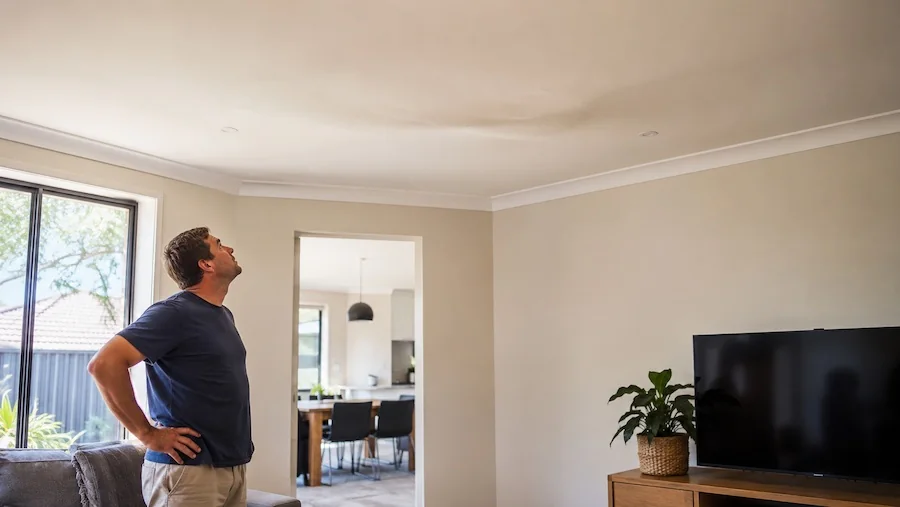
Stand in the room, turn the lights on, and look at the ceiling from a few different angles. Then walk to the opposite corner and look across the ceiling at a low angle, almost edge-on.
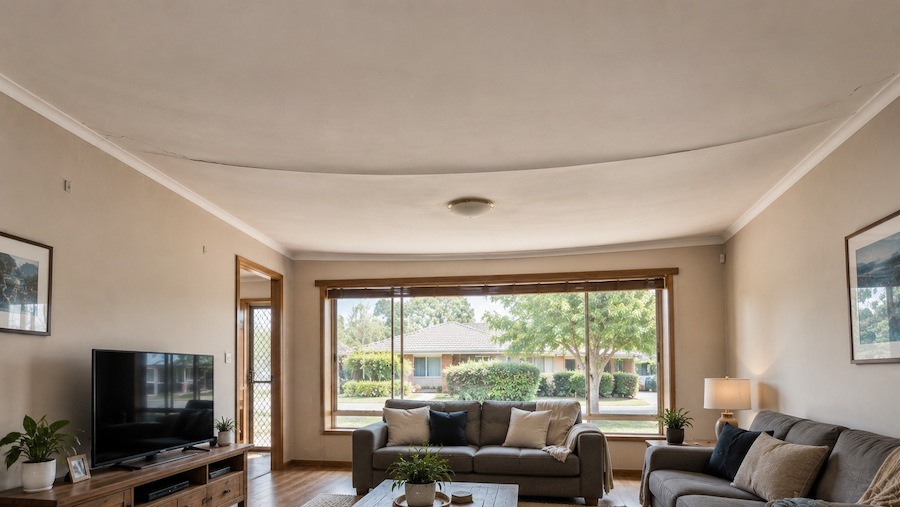
That second angle is the one that tells the truth. From directly underneath, even a significantly sagging ceiling can look flat. From across the room at a low angle, even subtle dips and bows show up as shadows or visible lines running across the surface.
If the ceiling reads as flat from every angle, you’re probably looking at a cracking issue rather than a structural one. If you can see a curve, a bow, or visible lines where the ceiling sheets meet the joists above, the sag is real, and it’s time to investigate further.
Hairline Cracks: Usually Just Cosmetic
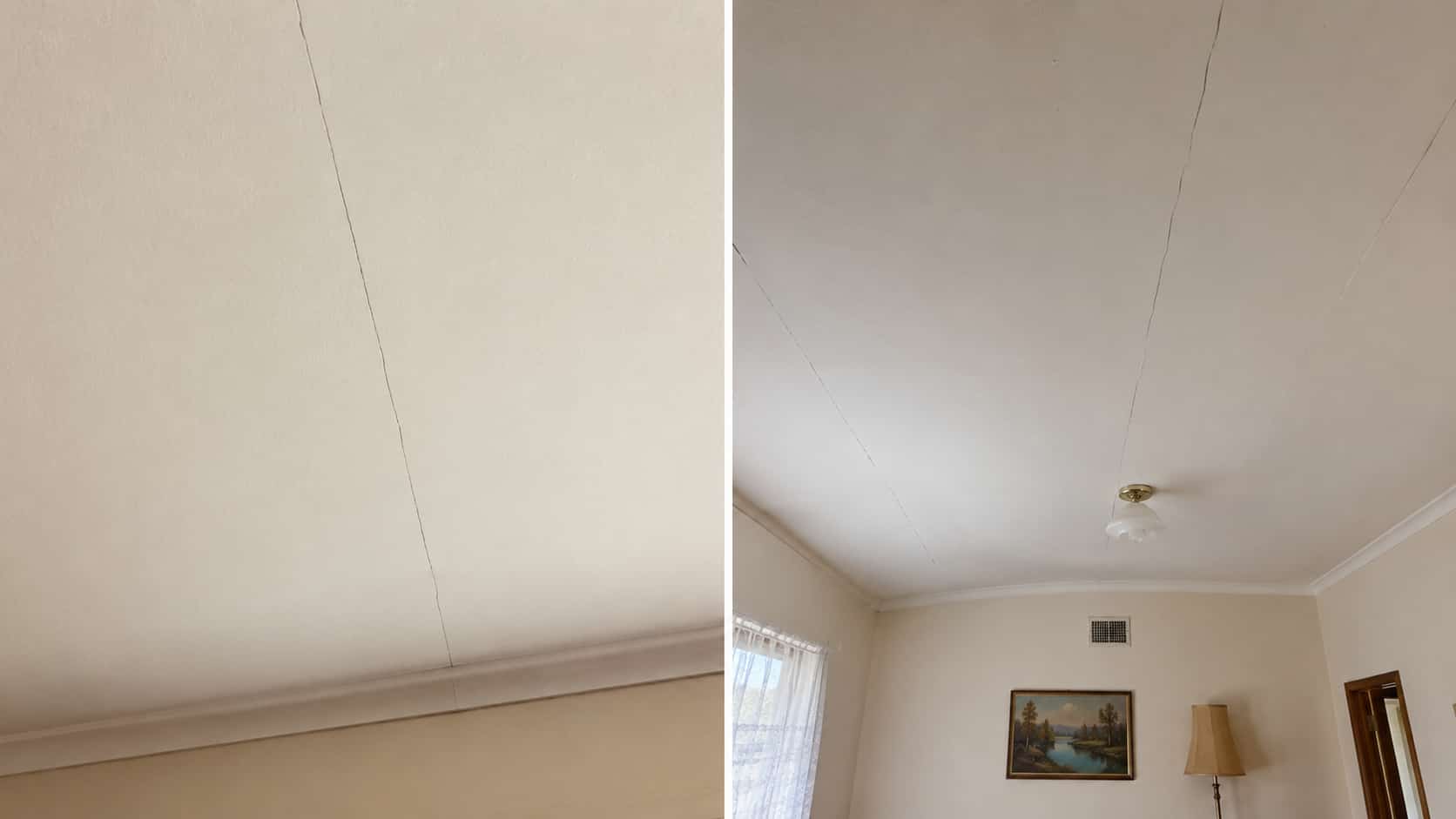
Hairline cracks are the most common ceiling issue we see, and most of the time, they’re not a structural problem. The natural movement of a house over time causes this. Timber framing expands and contracts with seasonal temperature changes, the slab settles slightly as the property ages, and the plaster surface above the framing flexes very slightly with each cycle.
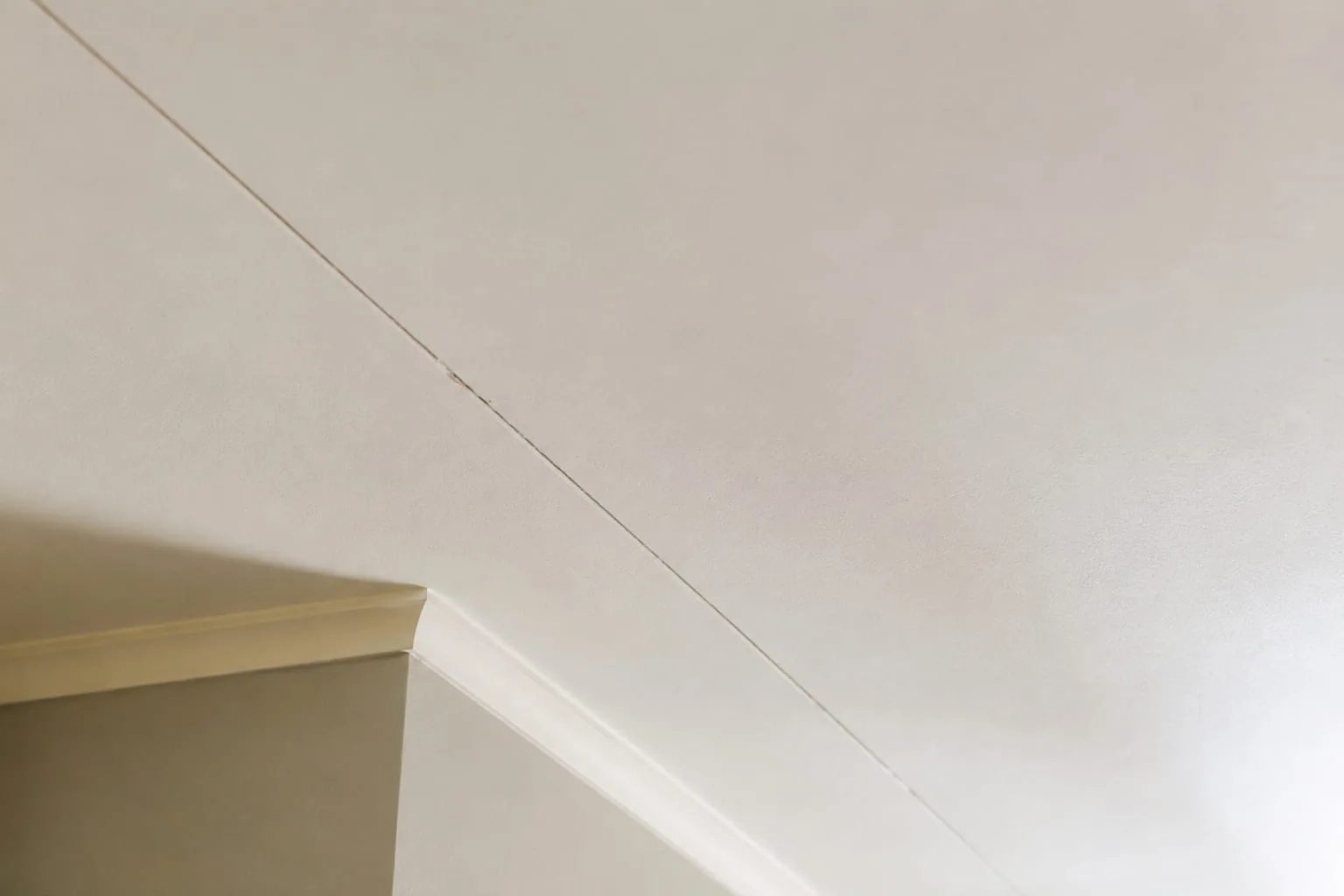
Typical hairline cracks have a few telltale features:
- They run in straight lines along sheet joins or where the ceiling meets the wall
- They’re thin enough that you can barely fit a credit card edge into them
- They appear and stay roughly the same over months and years, rather than growing visibly
- They’re often worst at the end of summer in Perth, after months of heat expansion above the ceiling
If your cracks fit this description and there’s no other sign of a sagging ceiling, water damage, or movement, you’re usually looking at a cosmetic issue.
Cracks That Should Worry You
Not all cracks are harmless. Here are the patterns that signal something more serious is going on above.
Spreading Cracks
A continuously growing crack is a sign that the underlying movement is ongoing. This could be a foundation movement, ongoing water damage, or progressive failure of the ceiling fixings above.
Cracks That Travel Down Walls
A ceiling crack that continues past the cornice and runs down a wall is a structural movement signal. The whole wall-ceiling plane is shifting, which usually points to foundation issues or significant timber movement in the framing above.
Cracks Around Light Fittings or Ceiling Roses
A crack radiating outward from a light fitting or ceiling rose suggests the ceiling sheet around that fixture has lost its hold above. The joist still supports the fitting, but the surrounding sheet no longer has full support, causing it to flex and crack around the fixed point. This is an early sign of a sagging ceiling that hasn’t fully developed yet.
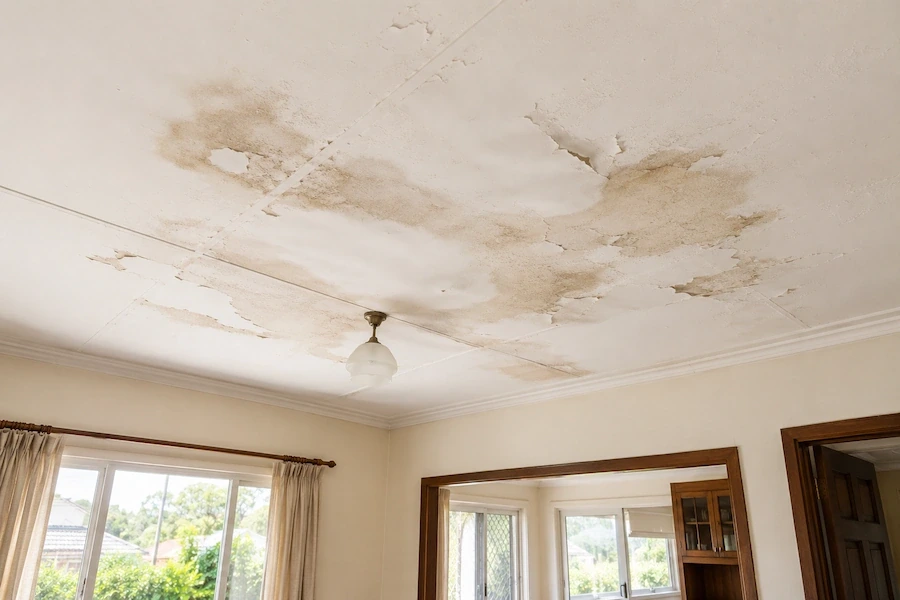
Cracks Paired With Brown or Yellow Staining
Any crack that’s discoloured, whether brown, yellow, or with a darker centre, is a water damage signal. Water has been tracking through the ceiling space, soaking the back of the plasterboard, and the staining is bleeding through to the visible side. Even if the leak has stopped, the affected sheet has lost structural integrity and is on its way toward sagging or partial failure.
What a Sagging Ceiling Actually Looks Like
Sagging is a mechanical failure. The ceiling material has lost its attachment to the timber framing above and is now hanging under gravity rather than being held in place.
In Perth specifically, this is most common in homes built between roughly 1950 and 1990, which is when plasterglass ceilings were the standard. Plasterglass is a denser, heavier material than modern plasterboard, and it was originally fixed to the timber joists using fibreglass straps dipped in plaster. The method was reliable for decades, but eventually fails as the strapping dries out and disintegrates in the heat of the roof cavity.
Once the strapping starts to fail, the ceiling progressively pulls away from the joists above. Sagging ceilings develop slowly at first as a slight bow that’s hard to notice without looking specifically for it, and then accelerate as more strapping fails and gravity does the rest.
The visual signs in order of severity:
Early Sagging
- A subtle bow or dish in the centre of the ceiling, most visible from across the room at a low angle
- Cracks appearing along the sheet joins, running parallel to the joists above
- Faint lines are visible across the ceiling where individual sheets are starting to drop slightly
- Cornice is starting to look slightly disconnected from the ceiling along one wall
Developing Sagging
- A visible curve in the ceiling when viewed from any angle
- Cracks are widening at the sheet joins
- Visible gaps appear where the ceiling meets the cornice or the wall
- Light fittings, vents, or ceiling roses are starting to look tilted or out of alignment
- Cracking or creaking sounds, especially when wind hits the roof or when the temperature changes
Late-Stage Sagging
- Significant visible drop in the centre of the ceiling, easily seen from any angle
- Plasterboard or plasterglass that’s visibly pulled away from the joists when you look in the roof cavity from above
- Large cracks running across the ceiling, sometimes with crumbling edges
- Sections of the ceiling that bounce or flex when you push gently from below
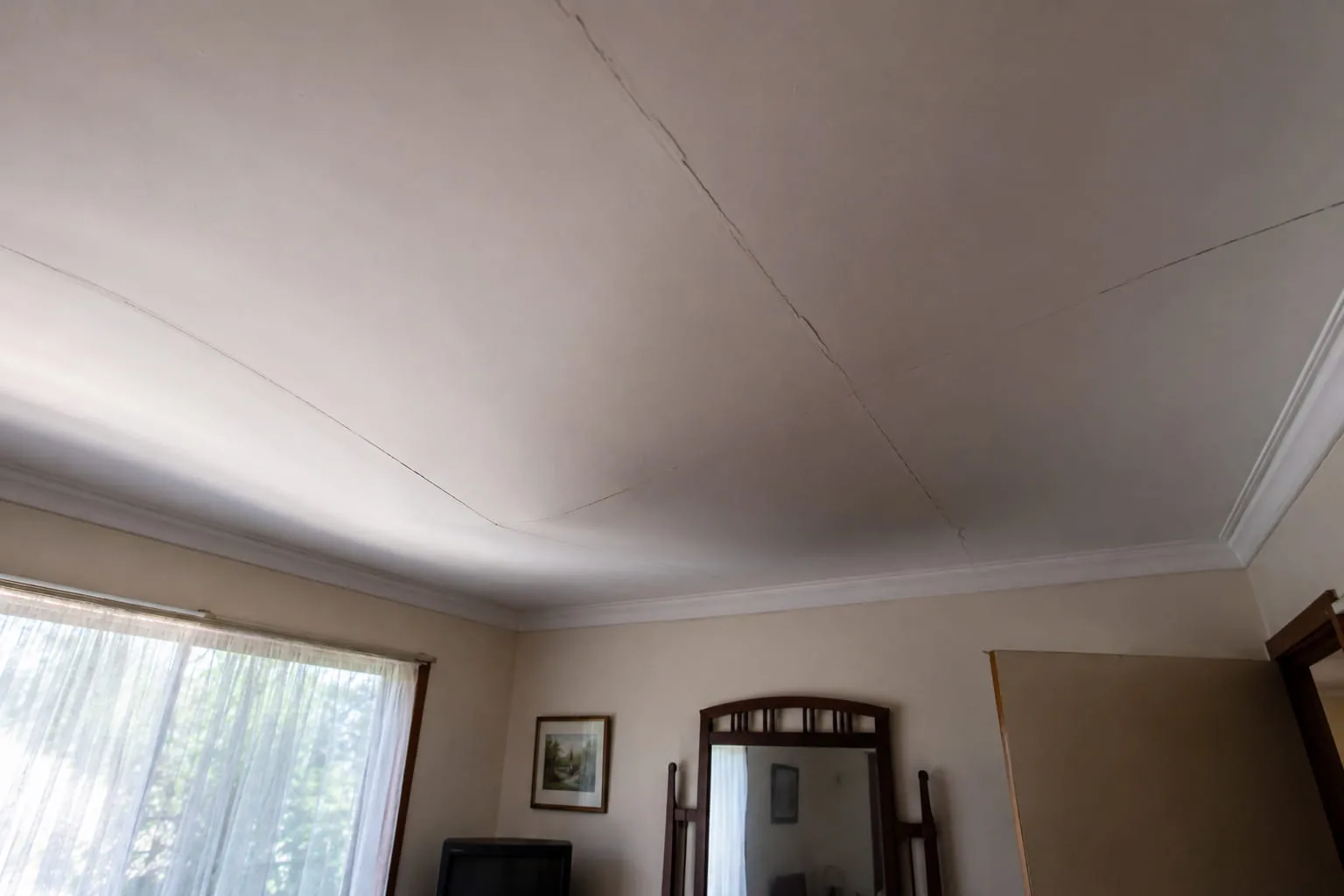
If your ceiling is at the late-stage point, the conversation isn’t “is this serious?” The conversation is about how soon someone can get to the property to make it safe.
The Plasterglass Tell-Tale (Specific to Older Perth Homes)
Houses built between roughly 1950 and 1990 almost certainly have plaster-glass ceilings rather than modern plasterboard. The two materials look very similar from below as a flat white painted surface, but they fail differently.
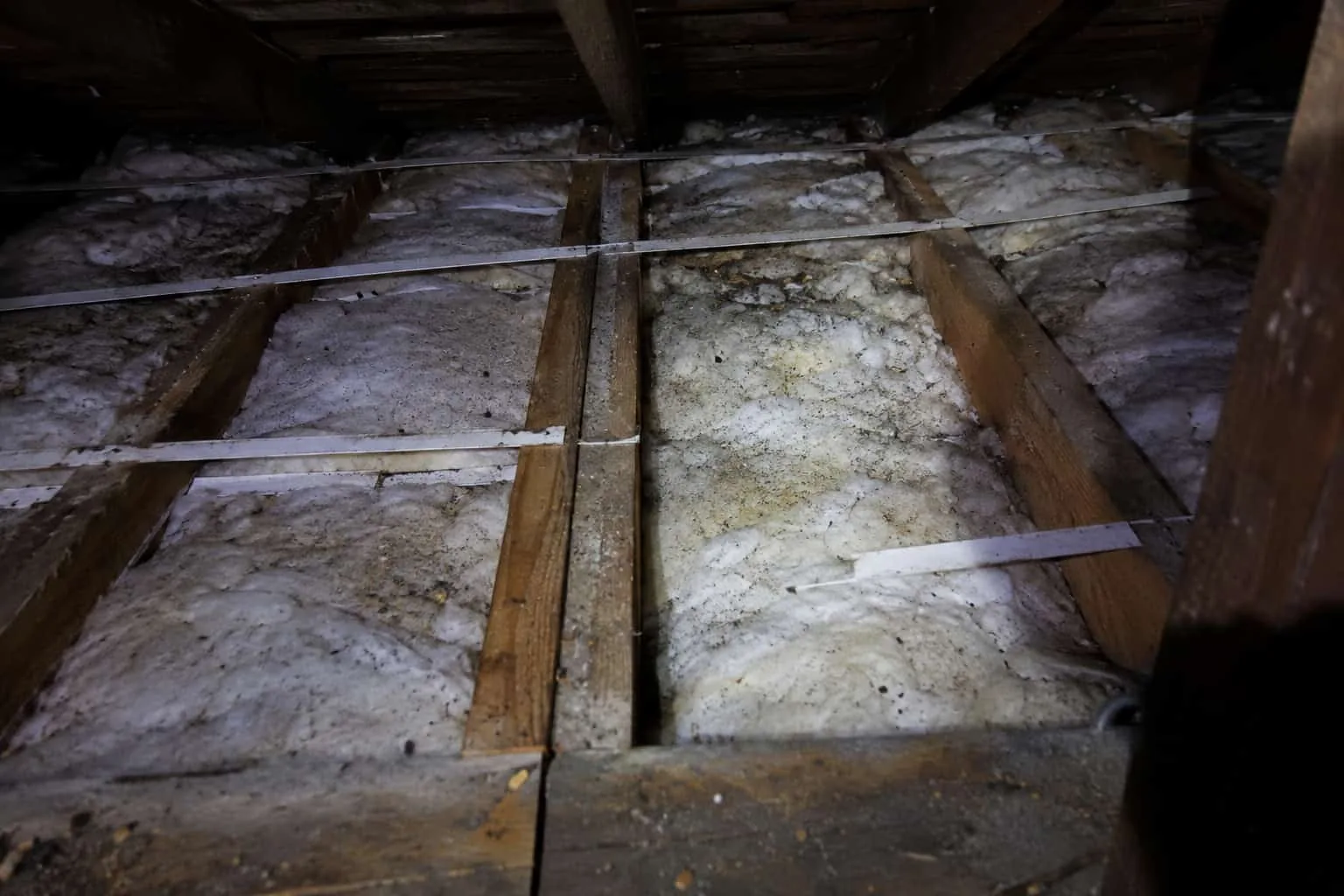
There are a few quick ways to tell if you’re dealing with plasterglass:
- Tap test: Plasterglass sounds noticeably denser and more solid than Gyprock when you tap it. A gyprock ceiling sounds slightly hollow; plasterglass sounds dense.
- In the roof cavity: Look up from inside the roof space. Plasterglass ceilings have visible fibreglass strapping running across the joists, with white or off-white strips of strapping material laid across each joist and dipped in plaster. Gyprock ceilings are screwed or glued directly to the joists with no strapping.
- Age of the home: Roughly speaking, anything built before 1990 in Perth is likely plasterglass. Anything from 1995 onward is almost certainly plasterboard. The crossover period of 1990 to 1995 could be either.
If you’ve confirmed you have plasterglass, the failure mode is predictable. The strapping eventually breaks down, and the sheets start sagging away from the joists. This is the most common ceiling repair we do in Perth, and it’s specifically why we use fibreglass roving re-strapping from above rather than trying to screw the sheets back up from below. Screwing into plasterglass causes more damage than it solves because the material isn’t designed to hold mechanical fixings. There’s more detail on the full re-strapping process on our sagging ceiling repair page if you want to understand how the fix is done.
Storm Damage and Water Ingress: the Wild Cards
Perth’s storm season, typically May through August, creates a different category of ceiling problems. Heavy rain, hail, and high winds can cause sudden water damage and impact damage that doesn’t fit the slow-degradation pattern of plasterglass sagging.
Look for these signs after any significant weather event:
- Fresh water staining anywhere on the ceiling, especially around the perimeter near external walls
- Damp patches or visible wet spots that weren’t there before
- New bulging or bowing in a localised area, often round or oval-shaped, rather than a uniform sag
- Cornice that’s pulled away from the wall or ceiling, especially after a storm
- Active dripping, even occasional drops, from any point on the ceiling
Storm damage usually qualifies as an insurance event under most home and contents policies, and the make-safe response (clearing fallen sections, tarping the area, stopping further damage) is typically approved as urgent expenditure by the insurer. If storm damage has affected the ceiling, homeowners should contact their insurer as soon as possible and document the damage with photos. The Insurance Council of Australia provides general guidance on storm damage claims and emergency make-safe work.
When to Just Wait and When to Get Someone Out
Here’s the honest decision framework based on what we see across hundreds of Perth ceilings every year.
Usually wait if:
- The crack is thin, in a straight line along a sheet join, and hasn’t grown in months
- The ceiling reads as flat from every angle, including across the room
- There’s no discolouration, no staining, no recent water damage
- The home is relatively new (post-2000), and there’s no specific event you can point to as the cause
Get someone out within the next few weeks if:
- You’re in an older Perth home with visible signs of early sagging
- You’re seeing cracks around light fittings or where the ceiling meets the cornice
- You’ve spotted discoloured cracks suggesting old water damage
- The cracks have grown noticeably over the past six months
- You’re planning a renovation and want an honest read on whether the ceiling can be refreshed or needs replacement
You should get someone out today or tomorrow if:
- You’re seeing significant visible sag in the centre of the ceiling
- There’s fresh water damage from a recent storm or burst pipe
- Sections of the ceiling are bouncing or flexing when pushed
- You can hear cracking or creaking sounds coming from the ceiling
- A section has partially fallen or is visibly hanging
The further down that list you go, the less the situation tolerates waiting. A sagging ceiling that’s reached the late-stage point goes from “concerning” to “in the loungeroom” with very little warning, especially during a hot Perth summer when the roof cavity heat accelerates whatever strapping or adhesive is still holding things together. For anything genuinely urgent, our emergency ceiling response page covers the make-safe workflow and typical response times.
What a Sagging Ceiling Inspection Actually Involves
If you’re not sure where your ceiling sits on the cracking-to-sagging spectrum, an inspection is the honest next step. From our side, that usually involves:
- A visual inspection from below, looking for the signs above and getting a sense of how far the issue has progressed
- Access to the roof cavity if it’s safe and the situation warrants it, to look at the strapping condition, identify any water tracking, and check the joist alignment from above
- Pressure testing in suspect areas to see how much movement there is in the ceiling material
- An honest assessment of whether the ceiling can be repaired in place, needs to be re-strapped from above, or has reached the point where replacement is the better-value option
Most Perth ceiling inspections take 30 to 45 minutes on site. A written quote follows once the scope is clear, with the repair-or-replace recommendation explained so you can make the call with full information. Where the recommendation is replacement rather than repair, our full ceiling replacement page covers what that work actually involves and the typical timeline.
Frequently Asked Questions
How do I know if a ceiling crack is serious?
Cracks that are growing, spreading, stained, or paired with visible sagging may indicate a structural issue rather than cosmetic movement. Cracks around light fittings or running down walls should also be inspected.
What does a sagging ceiling look like?
A sagging ceiling usually shows a visible bow or dip when viewed from across the room. You may also notice cracks, cornice separation, or uneven light fittings.
Can a sagging ceiling be repaired without replacement?
In many cases, yes, especially if the problem is identified early. Older plasterglass ceilings can often be re-strapped from above without full replacement.
What causes ceilings to sag?
The most common causes are age-related fixing failure, water damage, roof leaks, and heat buildup in the roof cavity. Older Perth plasterglass ceilings are especially prone to sagging over time.
Can water-damaged ceilings recover after drying out?
Even after drying, the ceiling material may remain weakened and prone to sagging later. Water staining should always be properly assessed.
What happens during a ceiling inspection?
An inspection usually involves checking for sagging, cracks, water damage, and roof cavity issues. The goal is to determine whether the ceiling should be repaired, re-strapped, or replaced.
The Bottom Line
Most ceiling cracks are cosmetic, and most ceilings show some signs of age over time. But the line between “leave it” and “this needs attention” is usually clearer than people expect once you know what to look for.
The pattern we see in Perth specifically is that older homes with plaster-glass ceilings will eventually need re-strapping or replacement work. It’s not a question of if, it’s a question of when. Catching the issue early, while it’s still in the repair-rather-than-replace zone, saves significant money and avoids the chaos of an unexpected ceiling collapse.
If you’ve read this post and recognised your ceiling in one of the descriptions above, the easiest next step is to send through a couple of photos and a quick description through our contact form or call us for an honest read on what you’re dealing with. Most assessments can happen from photos without a site visit, and we’ll only recommend an in-person inspection when the situation genuinely needs one.
Ceiling Services That Can Help
If this sounds like your ceiling, here is how we can sort it.